
Royal Caribbean Stock: 3 Risks That Force an Avoid

↓ Download the full research PDF · free, no email required
Royal Caribbean Stock: 3 Risks That Force a Hard Avoid in 2026
Key takeaways
- Royal Caribbean stock is a well-run premium operator trapped inside a leveraged, fixed-cost, discretionary-demand business model that breaks under recession stress.
- WP Score: 38/100 — fails the Wealth Preservation mandate on solvency, dividend history, and downside protection.
- At €272.48 (USD $312.51) the stock trades near 7x book and 58x free cash flow, leaving no asset floor and no margin of safety.
- Biggest risk: net debt-to-equity above 200% plus a 0.18x current ratio means another demand shock forces dilution, exactly as 2020 proved.
- Verdict: Avoid — the bear case return is negative and the probability of a >50% permanent loss exceeds our ceiling.
Executive summary
Royal Caribbean Cruises (RCL) is the second-largest cruise operator in the world, earning a 38/100 Wealth Preservation Score despite record 2024 earnings of $4.3 billion. The base case implies a modest 6-8% CAGR, but the bear case turns sharply negative with a realistic 30-50% drawdown and a repeat of the 2020 dividend elimination and 25% dilution. Our verdict on Royal Caribbean stock is Avoid: a good business with a balance sheet that guarantees severe stress in the next recession does not qualify as a capital-preservation vehicle at any price near current levels.
You are being asked to own Royal Caribbean stock at a moment when bookings are strong, earnings sit at records, and the share price has roughly tripled off its pandemic lows. The business is good. The balance sheet behind it is not. That gap defines the entire thesis. Independent data from Macrotrends confirms the leverage profile we examine below.
Royal Caribbean runs differentiated hardware in the Icon and Oasis classes, owns private destinations such as Perfect Day at CocoCay, and posted $17.9 billion in revenue for 2024. None of that is the problem. The problem is what a fixed-cost, high-leverage business does when discretionary demand evaporates. We have a recent, expensive answer to that question.
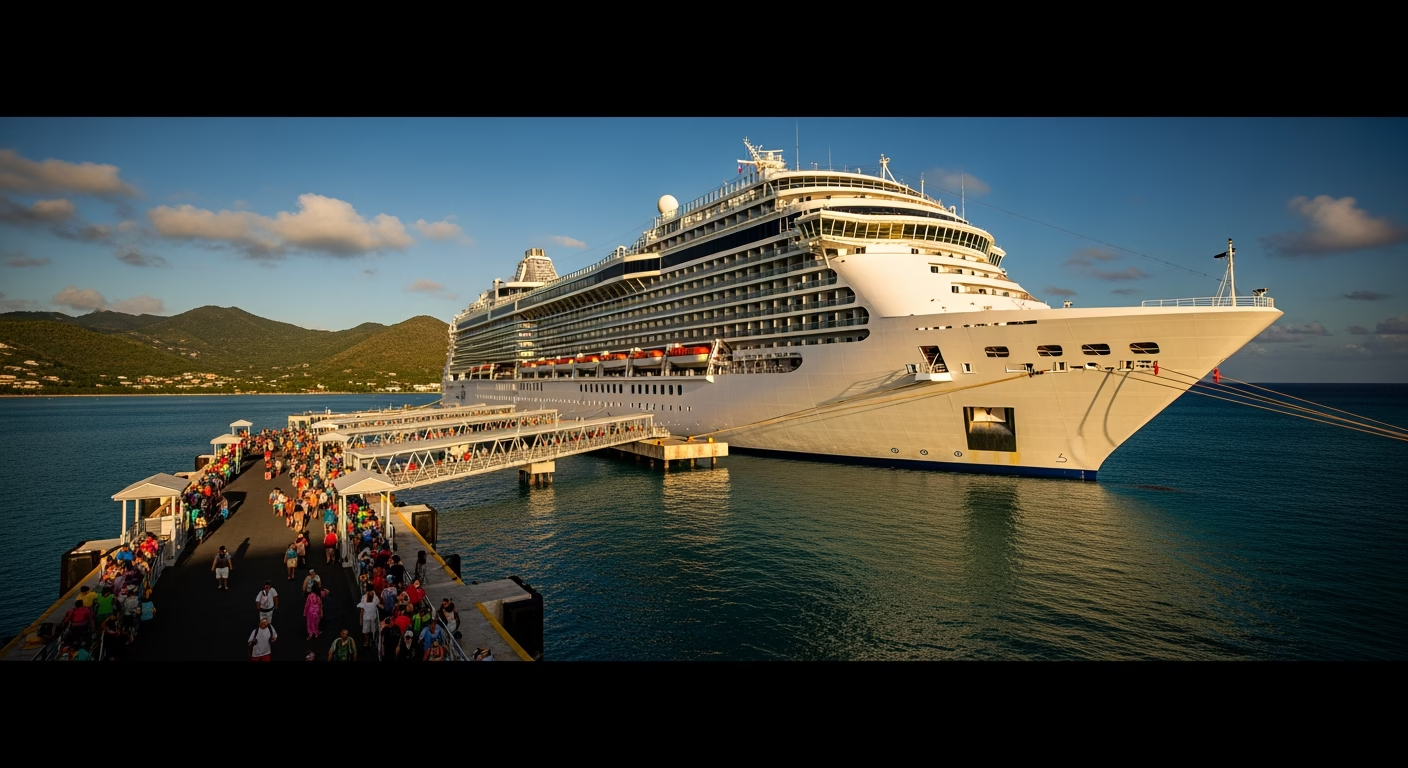
The Business Behind Royal Caribbean Stock
Royal Caribbean operates a vertically integrated cruise platform across three tiers. The mass-market brand is Royal Caribbean International, the premium brand is Celebrity, and the ultra-luxury arm is Silversea. A 50% joint venture in TUI Cruises and Hapag-Lloyd rounds out the portfolio. The company controls roughly 27% of worldwide cruise passengers across about 70 ships, according to industry figures published by the Cruise Lines International Association.
Revenue splits into two streams. Ticket fares cover the cabin and the voyage. High-margin onboard spending covers beverages, excursions, specialty dining, and casino activity. The onboard mix is what makes a recovered cruise line genuinely profitable, and management has executed well on capturing it.
The business is understandable and it is not in secular decline. Cruise demand is recovering and growing. The issue is structural. This is highly cyclical consumer discretionary spending, the first line item a household cuts when the economy turns. Under our framework, a cyclical of this type can proceed only with a fortress balance sheet and a valuation discount. Royal Caribbean stock offers neither. This RCL stock analysis treats survival as the first filter, not upside.
Our broader approach to screening cyclicals is documented in the Wealth Preservation methodology. The first filter is always survival, not upside. For a contrasting consumer name, see our equities research library where we screen for durable, low-leverage compounders.

The Balance Sheet That Disqualifies Royal Caribbean Stock
This is the decisive stage. Cruise operating costs are largely fixed once a ship is built. Crew, maintenance, port fees, and debt service do not fall when occupancy drops. Pair that fixed-cost spine with heavy leverage and you get a company that loses money fast in a downturn. This is the heart of the cruise stock leverage risk that defines the entire Royal Caribbean stock thesis.
The numbers are stark. Royal Caribbean carries debt-to-equity near 2.15x, with net debt cited as high as 232% of equity. The current ratio sits near 0.18x, meaning short-term obligations dwarf short-term assets by more than five to one. That is the opposite of a fortress. Figures filed with the SEC corroborate this debt-to-equity ratio.
Total debt sat around $22 billion in 2023, with ongoing refinancing reliance. Interest coverage is improving as earnings recover, but it is not confirmed at the level our framework demands for a cyclical. Free cash flow turned sharply negative through the pandemic years and fails any honest five-year test, as the cash-flow history compiled by StockAnalysis.com shows.
Run the stress scenario our framework requires: revenue down 30% for two years. Does Royal Caribbean remain solvent? Only with access to capital markets. Survival is not self-funded. Does the dividend hold? No. Does the company avoid a dilutive equity raise? No. We are not guessing here. The company did exactly this in 2020, eliminating the dividend, issuing equity and convertibles, and diluting pre-COVID holders by roughly 25%.
A current ratio of 0.18x and net leverage above 200% of equity disqualify a highly cyclical business under any preservation standard. The earnings recovery does not repair the fragility that reappears in every downturn. For more on how we evaluate balance-sheet strength, see our methodology.

Why the Royal Caribbean Stock Dividend Fails the Test
Royal Caribbean only recently reinstated a token dividend after eliminating it entirely during COVID. The yield sits well under 1%, below the 1.5% floor our income framework requires before a payout counts as a real return component.
The deeper problem is the track record. A reliable dividend needs an unbroken multi-year history. Royal Caribbean broke that streak in 2020 by cutting the payout to zero. For a mandate that treats dividends as dependable, durable return, a payer that eliminated its dividend within the last decade cannot be underwritten for income protection.
The token reinstatement signals confidence from management. It does not change the structural fact that this dividend is the first thing to disappear when demand softens. Compare that to the durable payers we cover in the equities research library, where dividend continuity through a full cycle is the entry requirement.
Valuation: No Margin of Safety in Royal Caribbean Stock
At €272.48 (USD $312.51), the stock looks reasonable on one metric and expensive on the ones that matter for downside protection. This Royal Caribbean Cruises valuation rests on metrics that protect capital rather than chase momentum.
The forward P/E of roughly 14.6x appears fair, but only if you accept the consensus 14% EPS CAGR, which itself assumes no recession arrives during your holding period. Trailing P/E near 17-19x sits slightly above the ten-year median of 16.8x. EV/EBITDA around 14-15x runs above pre-COVID norms.
The two metrics that protect capital tell a worse story. Price-to-book sits near 7.1x, far above cruise-industry norms in the low single digits. Price-to-free-cash-flow sits near 58x, distorted by the recovery and offering no cash-flow cushion.
For a preservation investor, these are the numbers that decide everything. There is no asset value floor near the current price and no cash yield to catch a falling share. Our framework requires a cyclical to trade at a discount before proceeding. Royal Caribbean stock trades at a full price. The margin of safety is negative on book and free cash flow, and thin on earnings.
Scenario Analysis and the Negative Bear Case
We weight three outcomes over a ten-year horizon that contains at least one recession, because every realistic decade does.
Bear case (25% weight): A recession hits. Discretionary cruise demand contracts while fixed costs hold. Earnings collapse. The 2020 analog saw peak-to-trough drawdowns above 70%. The dividend disappears again and a dilutive raise becomes likely. A realistic ten-year bear path is a 30-50% price decline with no dividend cushion. The bear case total return is sharply negative.
Base case (50% weight): Trend growth with no shock. Revenue grows high single digits, EPS grows mid-teens, deleveraging continues, and the multiple holds. The base case total return lands around 6-8% CAGR, barely at or below the inflation-plus-4% hurdle of roughly 7%.
Bull case (25% weight): Strong demand, margin expansion, and a re-rating. EPS growth beats consensus and leverage normalizes. The bull case total return reaches 12-15% CAGR.
Now the test that ends the discussion. Our framework asks one binary question: is the bear case total return positive? It is not. When the bear case CAGR is negative, downside protection is insufficient, and that is an automatic disqualification. A fat negative tail with no floor drags the probability-weighted return below the threshold a preservation investor can accept.
Want to follow this kind of analysis with real capital? Angelos Moschovakis is a verified eToro Popular Investor. You can copy the Moschovakis Capital equity portfolio and access the same preservation-first positioning discussed across our research.

Risk Assessment and Recession Profile
The risk register reads like a checklist of preservation failures. Net debt-to-equity above 200% creates refinancing dependence, with assets pledged as collateral. Discretionary middle-class demand is first to be cut in a downturn. Fixed costs for crew, maintenance, fuel, and debt service do not flex with occupancy.
Fuel and FX hit margins directly, and 2026 underperformance has been partly attributed to fuel. Capital intensity is severe: the company ordered ten new ships in 2023, locking in heavy multi-year capex. Dilution history shows a roughly 25% share-count increase since 2019. Insider ownership is negligible at about 0.38%, and third-party data flags insider selling during the rally.
The framework caps acceptable probability of a >50% permanent loss at 10-15% over a decade. Royal Caribbean stock carries a 15-25% probability of that outcome. It exceeds the ceiling. The recession profile is unambiguously vulnerable: revenue declined sharply, the dividend was eliminated, and capital was raised in 2020. Broader cyclical-demand context from the Bureau of Labor Statistics reinforces how quickly discretionary spending contracts in a downturn. The model is the risk, and the price does not compensate for it.
Management and Capital Allocation
Management quality is a genuine strength. Jason Liberty’s team steered the company through the COVID shutdown, restored profitability quickly, and prioritized deleveraging alongside high-return growth in Icon-class hardware and private destinations. Industry recognition in 2026 reflects real operational competence.
The qualifications matter. Capital allocation has leaned on debt and convertibles. Insider ownership is negligible, and third-party data such as that aggregated by Yahoo Finance flags selling into strength. Management did what survival required, but survival required diluting shareholders. A good operator cannot offset a balance sheet that forces dilution in every downturn.
This is the core lesson for any capital allocator: operational excellence and financial fragility can coexist in the same company. The framework scores the business, not the brochure. EBITDA growth and capital allocation skill cannot rescue a structure that fails the solvency test.
Peer Comparison: Best House on a Fragile Street
Against direct cruise peers, Royal Caribbean stock looks the strongest. Its leverage near 2.1x debt-to-equity is high, but Carnival (CCL) and Norwegian (NCLH) carry weaker balance sheets. Royal Caribbean trades at a premium to both, which the market awards for its superior franchise and newer fleet.
That comparison is the wrong one for a preservation mandate. None of the three cruise operators qualify. The relevant benchmark is asset-light travel franchises: Marriott, Hilton, and Booking Holdings. These businesses carry no shipbuilding capex, generate steadier free cash flow, and survived recent downturns without eliminating their dividends.
Royal Caribbean loses that comparison on durability every time. We cover a comparable asset-light travel platform in our Booking Holdings analysis, and the contrast in recession resilience is the entire point. Being the best house in a fragile neighborhood does not make the neighborhood safe. For risk-adjusted returns, the asset-light models win on every preservation metric that counts.
Moschovakis Capital — Quantitative Division
Automated FX Execution: A Separate Return Stream
While a leveraged cyclical like this one demands you bet against the next recession, our Quantitative Execution System operates on a different time horizon entirely. The system runs fully automated 24/7 with zero manual intervention, backed by a two-year audited track record. It offers an uncorrelated return stream that does not depend on cruise demand or credit cycles.
Final Verdict on Royal Caribbean Stock
The recommendation on Royal Caribbean stock is Avoid. Multiple absolute requirements fail at once. The bear case total return is negative, which alone removes downside protection. Solvency reads as marginal trending unacceptable for a highly cyclical business. The dividend was eliminated within the last decade. The probability of a >50% permanent loss exceeds our ceiling. The WP Score sits at 38, well below the 50 threshold.
What would change the view? A fundamentally restructured balance sheet with debt-to-equity below 1.0x and a current ratio moving toward 1.0x. A dividend proven sustainable through a downturn. A valuation offering real margin of safety on book and free cash flow. None of these conditions exist today.
This is a quality business and a competent team. It is not a wealth-preservation vehicle. The combination of leverage, fixed costs, and discretionary demand guarantees severe stress in the next recession, and the last one cost shareholders a dividend and 25% dilution. At €272.48, you are paying a full price for that risk profile. Hold cash or own durable, low-leverage compounders instead. For the full Royal Caribbean stock analysis methodology and our complete preservation framework, explore the equities research library at moschovakiscapital.com/equities/.
Frequently Asked Questions
Is Royal Caribbean stock a good investment in 2026?
For a capital-preservation mandate, no. Royal Caribbean stock earns a 38/100 Wealth Preservation Score because its leverage near 2.15x debt-to-equity, a 0.18x current ratio, and a history of dividend elimination create a negative bear case. The business is well run, but the balance sheet forces dilution in any recession.
What is Royal Caribbean Cruises’ dividend yield?
The current yield is under 1%, reflecting a recently reinstated token dividend. The company eliminated its dividend entirely in 2020, which disqualifies it as a reliable income source under our framework that requires an unbroken multi-year history and a yield floor of at least 1.5%.
Is Royal Caribbean stock overvalued?
On the metrics that protect capital, yes. Royal Caribbean stock trades near 7.1x book value and 58x free cash flow, leaving no asset floor and no cash cushion. The forward P/E of 14.6x looks fair only if you assume the consensus 14% EPS growth materializes without a recession.
How much debt does Royal Caribbean carry?
Total debt sat around $22 billion in 2023, with net debt-to-equity cited as high as 232%. The company relies on ongoing refinancing, and its 0.18x current ratio means short-term liabilities far exceed short-term assets. This leverage is the central reason for the avoid rating on Royal Caribbean stock.
Is Royal Caribbean stock worth buying for the long term?
Not for an investor focused on avoiding permanent loss. The probability of a >50% drawdown over a decade containing a recession sits at 15-25%, above our 10-15% ceiling. Asset-light travel franchises offer comparable upside with far better recession durability and continuous dividends.
Execution Infrastructure
For the execution of positions discussed in our research, we utilize the following institutional-grade platforms due to their regulatory compliance, liquidity, and reliability.
| Platform | Purpose |
|---|---|
| eToro | Equity execution — regulated, social trading infrastructure |
| Revolut | Multi-currency banking and FX |
| Interactive Brokers | Institutional-grade brokerage |
| Vantage | MT4/MT5 execution |
| Binance | Digital asset infrastructure |
| Hostinger | Web infrastructure |
Risk Disclaimer: Past performance is not indicative of future results. Moschovakis Capital is a technology provider and research publisher, not a licensed financial advisor. Trading and investing in financial instruments involves significant risk of loss. Do not invest more than you can afford to lose. The analysis presented is for informational purposes only and does not constitute personalized investment advice.
eToro Disclaimer: eToro is a multi-asset platform. The value of your investments may go up or down. Your capital is at risk. Copy trading does not amount to investment advice. The value of your investments may go up or down. Your capital is at risk. eToro USA LLC does not offer CFDs. Do not invest unless you are prepared to lose all the money you invest.
Affiliate Disclosure: Some links on this page are referral links. We may earn a commission at no extra cost to you. This does not influence our analysis or recommendations.
Royal Caribbean Cruises Ltd.: the full research PDF
The complete report behind this analysis — DCF model, valuation tables and scoring detail. No email, no form.
Download the PDFPDF · 43.4 KB
Frequently asked questions
Answers below are quoted directly from this analysis, as published on 21 June 2026.
What is the Wealth Preservation Score for Royal Caribbean Cruises Ltd.?
Is Royal Caribbean Cruises Ltd. a buy in 2026?
What are the main risks to the Royal Caribbean Cruises Ltd. thesis?
Research and opinion, not investment advice. Figures are as at the publication date above and are not maintained in real time.
Related Research
Don't have an eToro account yet? Open one here.