
GEHC Stock Analysis 2026: 7 Critical Hold Signals Now

↓ Download the full research PDF · free, no email required
GEHC Stock Analysis 2026: 7 Critical Hold Signals at $59.49
Key takeaways
- This GEHC stock analysis rates GE HealthCare at $59.49 with a 17.4% margin of safety to our $72 base-case fair value, yet probability-weighted return of 6.2% CAGR sits below our 7% hurdle.
- WP Score: 58/100 — Marginal band, dragged down by a 0.24% dividend and a balance sheet downgraded from fortress to adequate after the $2.3B Intelerad deal.
- Base case implies a $112 ten-year price target and 6.7% CAGR; bear case delivers -2.0% CAGR with capital not preserved in stress.
- Largest risk: China exposure at 14-15% of revenue plus tariff and memory-chip inflation, both cited in the FY2026 guidance cut.
- Verdict: HOLD / Watchlist — initiate at $52, full size at $46. At $59.49, park capital in cash and wait for Q2 confirmation.
Executive Summary
This GEHC stock analysis covers GE HealthCare Technologies at $59.49 against a base-case fair value of $72, a Wealth Preservation Score of 58/100, and a probability-weighted return of 6.2% CAGR that falls just short of our 7% institutional hurdle. The franchise is genuine — 5 million installed units, 14.2% ROIC, and a 45% recurring-revenue mix — but a symbolic dividend, post-deal leverage at 2.1x net, and a recent guidance cut argue for patience. Our GEHC stock analysis rates this HOLD with a $52 entry trigger.
Table of Contents
- The Investment Thesis in One Frame
- GEHC Stock Analysis: The Installed Base Moat
- Balance Sheet After the Intelerad Deal
- The Dividend Problem for Income Allocators
- GEHC Stock Analysis: Valuation at Trough Multiples
- Scenario Analysis and the 7% Hurdle
- Risk Assessment: China, Tariffs, Integration
- Peer Comparison vs Siemens and Philips
- Entry Triggers and Monitoring
- Final Verdict and Capital Allocation
- Frequently Asked Questions
The Investment Thesis in One Frame
You are looking at a sound business at a fair-but-not-cheap price. GE HealthCare owns a 5 million-unit installed base of imaging and patient-care equipment that drives 45% recurring revenue through service contracts, contrast agents, and software. That is a real moat. Hospitals do not rip out a $2M MRI to switch vendors, and the data flywheel feeding the Edison AI platform compounds the lock-in. Industry context from Imaging Technology News confirms switching cycles measured in decades, not quarters.
The math, however, is tight. Probability-weighted return clocks in at 6.2% CAGR against our 7% inflation-plus-4% hurdle. The gap is small but it is the gap that separates a position from a watchlist line. Our Wealth Preservation methodology requires a margin of safety on both price and return adequacy, and our GEHC stock analysis clears the first test while missing the second.
Three frictions explain the HOLD rating. The dividend yield is 0.24% — a quarterly $0.035 payment that contributes nothing meaningful to total return. The Intelerad acquisition closed Q1 2026 at $2.3B all-cash, pushing net debt to $7.8B against $3.64B EBITDA. Management cut FY2026 guidance per the latest SEC filings to $4.80–$5.00 adjusted EPS from $4.95–$5.15, citing tariffs, memory-chip costs, and a contrast-agent supplier issue.
The stock fell to $59.49 because the market is repricing execution risk. We agree with the repricing. We do not yet agree with the entry.
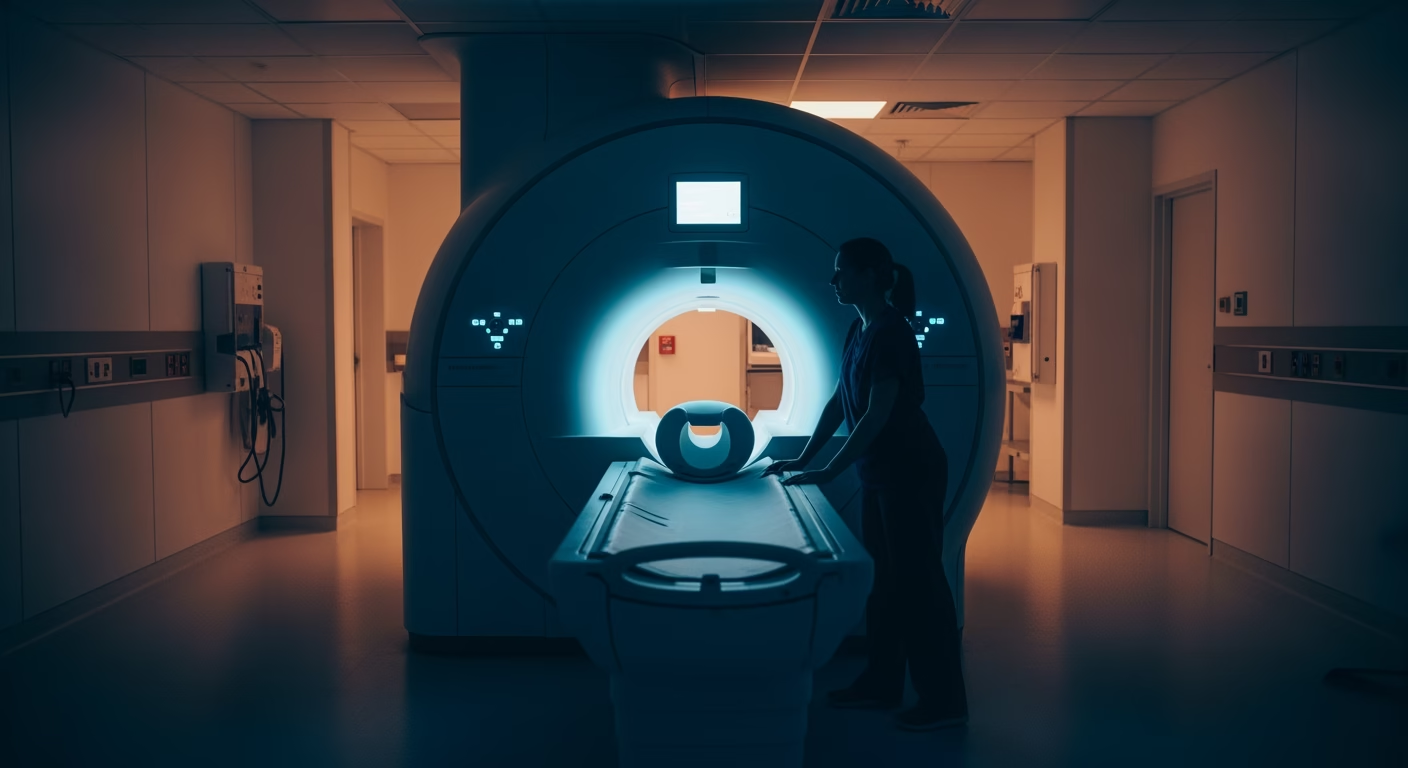
GEHC Stock Analysis: The Installed Base Moat
The competitive position is the strongest part of the file. GE HealthCare holds the #1 or #2 share position in most modalities — MRI, CT, ultrasound, mammography, and patient monitoring — against Siemens Healthineers and Philips. The installed base is not going anywhere over the next decade. A radiology department running 40 GE MRI scanners with integrated workflow and trained technicians does not switch on price alone.
What sustains the moat
Three structural features. First, switching costs run high: imaging modalities are 7-15 year capital purchases with sticky service contracts and trained-technician dependencies. Second, scale in R&D — $1.3B annually, 11,000+ patents, and 85+ FDA-cleared AI/ML devices — keeps the product roadmap ahead of mid-market entrants. Third, the data flywheel: every connected scanner feeds Edison, every Edison improvement deepens the lock-in.
ROIC of 14.2% sits comfortably above weighted average cost of capital. That is the cleanest single signal that the moat translates to economic returns rather than accounting earnings. Capital efficiency is the part of this equity research file we score highest.
What threatens the moat
Threat assessment is MODERATE, not low. Siemens Healthineers shipped the Naeotom Alpha photon-counting CT first and holds a lead in that modality. Chinese OEMs Mindray and United Imaging pressure the mid-market on price. China VBP — volume-based procurement — compresses margins on 14-15% of revenue directly. The risk is incremental margin compression rather than displacement, but compression compounds.
Balance Sheet After the Intelerad Deal
The Intelerad acquisition is the file’s pivot point. The deal closed Q1 2026 at $2.3B all-cash, adding enterprise imaging and radiology workflow software to the platform. Strategically the logic holds — recurring software revenue at higher margins than hardware. Financially the cost shows.
Total debt now stands at $10.1B against $2.3B cash. Net debt of $7.8B against $3.64B EBITDA gives net leverage of 2.1x — manageable but no longer fortress-grade. Interest coverage of roughly 6.5x clears our 5x threshold but with less cushion than 12 months ago. The current ratio of 1.2x sits below our 1.5x preference.
Free cash flow of $1.51B trailing remains positive and has been positive every year since spin. The senior notes maturity profile — 2028 and 2035 plus a three-year term loan — shows no near-term cliff. Solvency is ADEQUATE.
The downgrade from fortress to adequate matters. In our framework it pulls the Balance Sheet component score from a likely 32/40 to 22/40. That single adjustment moves the composite WP Score from BUY territory into the Marginal band.
Recession stress test: if revenue drops 25% over two years in a hospital capex freeze, service revenue cushions the decline thanks to the 45% recurring mix. EBITDA likely falls to $2.4-2.6B. Interest coverage compresses to roughly 4x. The risk is forced deleveraging that delays buybacks and crimps the $1.3B R&D budget.
The Dividend Problem for Income Allocators
The dividend is technically rock solid and practically irrelevant. Annual payment of $0.14 against $4.55 EPS gives a 3% payout ratio. FCF payout ratio sits at 4%. There is no scenario short of insolvency where the dividend is at risk.
The yield, however, is 0.24%. At that level the dividend exists for index inclusion and signaling, not for shareholders seeking income. For a wealth preservation mandate this matters: you lose the dividend cushion that protects total return when prices stagnate. A 3% yield carries you through a flat decade. A 0.24% yield does not.
Management has signaled buybacks as the preferred capital return mechanism — 1.4M shares repurchased Q1 2026 for $100M at depressed prices, a well-timed execution. We score this as accretive capital allocation but it does not solve the income problem for a portfolio benchmarked to total return with downside protection.
For income-focused capital, look at Abbott Laboratories or Chubb instead. Both deliver dividend cushions GEHC structurally cannot.

GEHC Stock Analysis: Valuation at Trough Multiples
Valuation is the strongest case for the bull side. Trailing P/E of 13.1 against $4.55 EPS sits well below the post-spin 17-19 average. Forward P/E of 12.4 on the midpoint $4.90 guidance compares to a sector average near 18 per S&P healthcare sector data. EV/EBITDA of 10.6 trades at meaningful discounts to Abbott at 21.8 and to Intuitive Surgical at 46.2.
The fair value calculation
We anchor normalized EPS at roughly $5.50 by year five, reflecting Intelerad accretion plus organic 4-5% revenue growth and operating leverage. Apply a fair multiple of 14x for a quality medtech franchise with lower secular growth than peers. That gives a year-five fair value near $77. Discounted to today at 8% yields $72. Against $59.49, the margin of safety lands at 17.4%.
That is the right number for a quality compounder at a guidance-cut trough. It is not the right number to size up aggressively. The 17% cushion absorbs ordinary noise but not a second guidance cut or an Intelerad integration miss.
Why the discount exists
The trough multiple reflects three concerns the market has priced in. Tariff uncertainty on memory chips and freight. China VBP overhang on 14-15% of revenue. Intelerad integration risk on a $2.3B all-cash deal. None of these are unrecognized opportunities. They are known frictions awaiting resolution.
Scenario Analysis and the 7% Hurdle
Three scenarios drive the probability-weighted output of this GEHC stock analysis. Bear case at 25% weight assumes a US-China trade-war intensification, a 2027 hospital capex freeze, margin compression to 12% operating, and multiple contraction to 10x P/E. Ten-year price target $58, total CAGR -2.0%.
Base case at 50% weight assumes 4-5% revenue CAGR with Intelerad accretion, 7% EPS CAGR from operating leverage and buybacks, and multiple normalization to 14x by year ten. Ten-year price target $112, total CAGR 6.7%.
Bull case at 25% weight assumes photon-counting CT and theranostics drive share gains, AI mix shift expands operating margins to 18%, and the multiple re-rates to 18x. Ten-year price target $185, total CAGR 13.5%.
Probability-weighted return: 6.2% CAGR. Below the 7% hurdle by 0.8 points. That is the core problem. The bear case is the part of the file that matters most for capital preservation. A -2.0% CAGR over ten years means real capital destruction after inflation per BLS inflation data. The 25% weight is not aggressive — it reflects genuine, observable risks rather than tail scenarios.
Risk Assessment: China, Tariffs, Integration
Six risks ranked by impact times probability.
China exposure (14-15% of revenue). VBP procurement reform plus geopolitical tariffs. Direct margin and volume risk. Already showing in 2026 guidance.
Tariff and supply chain inflation. Cited as the primary reason for the guidance cut. Memory chips, helium for MRI cooling, freight costs.
Hospital capex cyclicality. A recession scenario delays equipment orders by 6-18 months. The $21.8B backlog cushions but does not eliminate. American Hospital Association capex surveys confirm the historical pattern.
Intelerad integration. $2.3B acquisition closed Q1 2026. Goodwill writedowns possible if synergies miss the contracted recurring revenue ramp.
Cybersecurity. An FDA recall of GE HealthCare image viewers sits in current risk disclosures. Connected device exposure rises with every software acquisition.
Competitive pressure. Siemens Healthineers’ Naeotom Alpha first-mover position in photon-counting CT keeps share at risk in a high-growth modality.
Probability of >50% permanent loss: 8%. Below our 10% framework threshold but not by much. Recession profile: SENSITIVE, not RESILIENT.
Peer Comparison vs Siemens and Philips
Against the Big Three medical imaging franchises, this GEHC stock analysis profiles cleanly on capital efficiency and valuation, less cleanly on income and balance sheet.
| Dimension | GEHC | Siemens Healthineers | Philips | Best for Preservation |
|---|---|---|---|---|
| Net Debt/EBITDA | 2.1x | 2.4x | 1.8x | Philips |
| EV/EBITDA | 10.6 | 14.5 | 12.0 | GEHC |
| Dividend Yield | 0.24% | 1.8% | 1.6% | Siemens |
| ROIC | 14.2% | 11.5% | 8.5% | GEHC |
| Recurring Revenue % | 45% | 50% | 48% | Siemens |
| Forward P/E | 12.4 | 18.5 | 16.0 | GEHC |
GEHC offers the best valuation and capital efficiency among the three. Siemens offers the best income and stability. Philips offers the safest balance sheet but the weakest profitability. For a preservation mandate seeking valuation discount with quality, GEHC is the choice — at the right entry price.

Moschovakis Capital — Quantitative Division
Automated FX Execution: A Separate Return Stream
While this GEHC equity thesis demands patience over a 3-5 year horizon — waiting for $52 entries and Q2 guidance confirmation — our Quantitative Execution System operates on a different time horizon entirely. Two-year audited track record. Fully automated 24/7 FX execution. Zero manual intervention. An uncorrelated return stream that runs while equity capital sits in cash waiting for the right price.
Entry Triggers and Monitoring
The framework converts research into a written plan. Watchlist triggers below.
Initiate position at standard size: price drops below $52. That level delivers an 8.5%+ base CAGR and pushes the WP Score above 65.
Upgrade to full position: price drops below $46.
Increase conviction: FY2026 guidance reaffirmed at the Q2 print. Two consecutive clean quarters resolve the most acute uncertainty.
Re-rate base case higher: Intelerad delivers contracted recurring revenue with no goodwill impairment.
Sell or re-review triggers if a position is later established: net debt to EBITDA above 3.0x; a second consecutive guidance cut; Intelerad goodwill impairment; FCF margin below 5% for two quarters; price exceeds $90 (fair value plus 25%); China revenue declines more than 25% year on year.
The discipline is the trigger sheet. At $59.49 we wait. At $52 we act. For a parallel HOLD-then-buy framework, see our Amphastar Pharmaceuticals analysis.
Final Verdict and Capital Allocation
HOLD / Watchlist. Target entry $52. This GEHC stock analysis closes with a clear discipline.
Why HOLD rather than BUY: base case total return of 6.7% CAGR sits below the 7% hurdle. The composite WP Score of 58 places GEHC in the Marginal band, not the 65+ BUY band. The bear case shows -2% CAGR — capital not preserved in stress. Dividend yield of 0.24% provides no income cushion. The balance sheet was downgraded from fortress to adequate post-Intelerad.
Why not AVOID: this is a quality business with a durable moat. Trading at trough valuation (12.4x forward P/E versus 17-19 historical). ROIC of 14.2% well above WACC. Bear case price decline contained at roughly 3% from current. A 17% margin of safety to base-case fair value.
A 12% price decline from current shifts this to a BUY. At $59.49, the math says wait. Park the capital in a 4% high-yield savings account per current Federal Reserve H.15 rates and watch for either a further drawdown or a Q2 print that reaffirms guidance and de-risks the thesis. For comparable healthcare files where the math already clears the hurdle, see our published Abbott Laboratories analysis.

Execution: Copy the Equity Portfolio
Want to follow this research with real capital? Angelos Moschovakis is a verified eToro Popular Investor. Copy the Moschovakis Capital equity portfolio on eToro and access the same positions discussed in this and every other research note — every entry backed by published analysis, every exit triggered by the framework above. When GEHC clears $52 and enters the portfolio, you will be there.
Frequently Asked Questions
Is GEHC a good investment in 2026?
Our GEHC stock analysis rates the stock HOLD at $59.49. The business is high quality with a 14.2% ROIC and a durable installed-base moat, but the probability-weighted 10-year return of 6.2% CAGR sits below our 7% institutional hurdle. We become buyers at $52 and full-size buyers at $46.
What is GE HealthCare’s dividend yield?
GEHC pays an annual dividend of $0.14 per share, or $0.035 quarterly, for a yield of 0.24% at $59.49. The payout ratio sits at roughly 3% of EPS and 4% of free cash flow. The dividend is rock solid but symbolic — management favors buybacks for capital return.
Is GEHC stock overvalued or undervalued?
GEHC trades at 12.4x forward P/E and 10.6x EV/EBITDA, both meaningful discounts to the post-spin 17-19 historical range and to medtech peers. Our base-case fair value is $72, implying a 17.4% margin of safety from $59.49. The valuation is attractive; the return profile is the constraint.
How does the Intelerad acquisition affect GEHC’s balance sheet?
The $2.3B all-cash Intelerad deal closed Q1 2026 and pushed total debt to $10.1B against $2.3B cash. Net debt to EBITDA rose to 2.1x — manageable but no longer fortress-grade. Interest coverage of 6.5x still clears our 5x threshold. We downgraded the balance sheet rating from FORTRESS to ADEQUATE in this GEHC stock analysis.
Is GEHC stock worth buying after the 2026 guidance cut?
Not yet at $59.49. Management cut FY2026 adjusted EPS to $4.80–$5.00 and free cash flow to roughly $1.6B, citing tariffs, memory-chip costs, and a contrast-agent supplier issue. We want either a Q2 print reaffirming guidance or a drawdown to $52 before initiating a position.
For the full GEHC stock analysis methodology and the complete Moschovakis Capital research framework, explore the equities library.
Execution Infrastructure
For the execution of positions discussed in our research, we utilize the following institutional-grade platforms due to their regulatory compliance, liquidity, and reliability.
| Platform | Purpose |
|---|---|
| eToro | Equity execution — regulated, social trading infrastructure |
| Revolut | Multi-currency banking and FX |
| Interactive Brokers | Institutional-grade brokerage |
| Vantage | MT4/MT5 execution |
| Binance | Digital asset infrastructure |
| Hostinger | Web infrastructure |
Risk Disclaimer: Past performance is not indicative of future results. Moschovakis Capital is a technology provider and research publisher, not a licensed financial advisor. Trading and investing in financial instruments involves significant risk of loss. Do not invest more than you can afford to lose. The analysis presented is for informational purposes only and does not constitute personalized investment advice.
eToro Disclaimer: eToro is a multi-asset platform. The value of your investments may go up or down. Your capital is at risk. Copy trading does not amount to investment advice. The value of your investments may go up or down. Your capital is at risk. eToro USA LLC does not offer CFDs. Do not invest unless you are prepared to lose all the money you invest.
Affiliate Disclosure: Some links on this page are referral links. We may earn a commission at no extra cost to you. This does not influence our analysis or recommendations.
GE HealthCare Technologies Inc.: the full research PDF
The complete report behind this analysis — DCF model, valuation tables and scoring detail. No email, no form.
Download the PDFPDF · 46.3 KB
Frequently asked questions
Answers below are quoted directly from this analysis, as published on 30 April 2026.
What is the Wealth Preservation Score for GE HealthCare Technologies Inc.?
Is GE HealthCare Technologies Inc. a buy in 2026?
What is the fair value estimate for GE HealthCare Technologies Inc.?
Does GE HealthCare Technologies Inc. offer a margin of safety?
What are the main risks to the GE HealthCare Technologies Inc. thesis?
Research and opinion, not investment advice. Figures are as at the publication date above and are not maintained in real time.
Related Research
Don't have an eToro account yet? Open one here.