
This Dutch Bros stock analysis examines one of the most compelling unit-growth stories in the U.S. quick-service restaurant sector — and why our Wealth Preservation Framework rates BROS as a HOLD/WATCHLIST at current levels. Dutch Bros Inc. (NYSE: BROS) delivered a record-breaking FY2025, with revenues surging 28% to $1.64 billion and adjusted EBITDA growing 31% to $303 million. But exceptional business momentum does not automatically translate into an exceptional entry point for capital preservation investors.
Our institutional Dutch Bros stock analysis applies growth-adapted modifications to the Moschovakis Capital Wealth Preservation Framework, evaluating downside protection, unit economics, balance sheet resilience, and probability-weighted scenario outcomes across a 5-year horizon. The conclusion: this is an exceptional business trading at a fair — but not yet asymmetrically favorable — valuation.
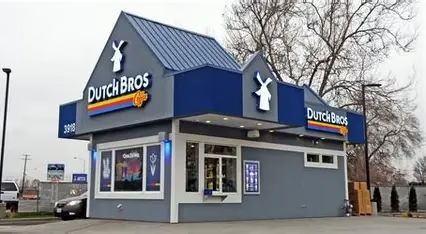
Table of Contents
- Executive Summary — Bottom Line Up Front
- Investment Thesis: Why Dutch Bros Demands Attention
- Business Quality & Competitive Moat Assessment
- Financial Fortress Analysis — Growth-Adapted
- Growth Engine: Unit Economics & Expansion Runway
- Management & Capital Allocation
- Valuation & DCF Scenario Analysis
- Risk Assessment Matrix
- Position Sizing & Entry Strategy
- Final Recommendation & Monitoring Triggers
1. Executive Summary — Bottom Line Up Front
Recommendation: HOLD / WATCHLIST Current Price (Feb 2026): $50.82 Fair Value Range: $58 – $72 Target Entry Price: $42 – $46 Probability-Weighted 5-Year CAGR: +18.3% Wealth Preservation Score: 72 / 100
This Dutch Bros stock analysis identifies BROS as a rare high-growth compounder with exceptional unit economics, a cult-like brand following, and a proven expansion playbook that could triple its store count over the next decade. FY2025 revenues hit $1.64 billion (+28% YoY), adjusted EBITDA reached $303 million (+31% YoY), and the company posted 19 consecutive years of positive same-shop sales growth. Q4 2025 was particularly impressive: revenue surged 29.4% to $443.6 million, crushing estimates by 4.5%, while adjusted EPS of $0.17 beat consensus by 73.9%.
The risk that tempers enthusiasm: At ~100x trailing earnings and ~35x EV/EBITDA, the current valuation embeds significant growth expectations. Zero dividend income provides no downside cushion. A beta of 2.56 implies a market correction of 30% could translate to a 50-70% drawdown in BROS — even if operations remain pristine.
Our framework identifies a target entry of $42–$46 where the growth-adjusted risk/reward becomes asymmetrically favorable for capital preservation investors willing to allocate a modest growth sleeve.
This is a summary of our institutional Dutch Bros stock analysis. Our proprietary 23-page PDF contains the full DCF model, price sensitivity tables, shop-level unit economics breakdown, and specific entry/exit zones calibrated to the Wealth Preservation Framework. [Sign up to download the full PDF analysis →]
2. Investment Thesis: Why Dutch Bros Demands Attention
The core thesis in this Dutch Bros stock analysis rests on three pillars that institutional investors should evaluate carefully.
Pillar 1: The Unit Economics Machine. Dutch Bros’ shop-level returns are exceptional. Average Unit Volumes reached a record $2.1 million in FY2025, with company-operated shop contribution margins of 27-29%. New shop build costs have been declining through the shift to build-to-suit construction, compressing the payback period to approximately 2.5-3 years with shop-level ROICs exceeding 35%. This is the fundamental engine that justifies aggressive expansion — and it is improving, not deteriorating.
Pillar 2: The Expansion Runway. With 1,136 locations today versus Starbucks’ approximately 16,500 U.S. locations and Dunkin’s 9,000+, Dutch Bros has massive whitespace. Management has indicated a long-term target of 4,000+ shops. At the current pace of 160-180 new openings per year (accelerating), the company has 15-20+ years of runway before approaching saturation. The January 2026 acquisition of Clutch Coffee Bar (20 locations in the Carolinas) signals accelerating East Coast expansion — precisely the kind of disciplined, strategic tuck-in acquisition our framework rewards.
Pillar 3: Same-Shop Sales Acceleration. The acceleration from +1.0% in FY2024 to +5.6% in FY2025 is remarkable. Q4 same-shop sales growth hit +7.7%, driven by 5.4% transaction growth — a sign of genuine demand rather than price-driven comparables. This occurred during a period when many QSR peers experienced traffic declines. The 2026 guidance of +3-5% represents thoughtful conservatism given the strong Q4 exit rate.
The combination of exceptional unit economics, a decade-plus expansion runway, and accelerating same-store performance creates a compounding dynamic that few QSR companies can match. The question is not whether this is a good business — it is whether the current price adequately compensates for the risks.
3. Business Quality & Competitive Moat Assessment
Any rigorous Dutch Bros stock analysis must evaluate moat durability. Dutch Bros Inc. is the third-largest drive-thru coffee chain in the United States, founded in 1992 in Grants Pass, Oregon. The company operates and franchises drive-thru shops specializing in hand-crafted beverages including espresso-based drinks, proprietary Blue Rebel energy drinks, teas, lemonades, smoothies, and an expanding food menu.
3.1 The Moat Structure
Brand Power & Culture (Durability: 8/10). Dutch Bros’ unique ‘broista’ culture creates genuine emotional connection with customers. Employees are trained to engage customers personally, creating loyalty that transcends product quality alone. This cultural differentiation is the hardest competitive advantage for rivals to replicate because it requires deep organizational embedding — not just marketing spend. The 19 consecutive years of positive same-shop sales growth validates this moat’s durability.
Loyalty Program Switching Costs (Durability: 7/10). The Dutch Rewards program now accounts for over 66% of transactions, with mobile order reaching 14% of transactions in Q4 2025. This creates meaningful behavioral lock-in and provides the company with valuable first-party data for personalization and targeted promotions.
Cost Advantages (Durability: 7/10). The drive-thru-only format with a small footprint (800-1,200 sq ft) keeps build-out costs significantly below traditional cafe formats. Average transaction times are industry-leading. This operational efficiency enables placement in high-traffic locations with lower real estate costs than competitors like Starbucks.
3.2 Competitive Threat Assessment
The primary threats include Starbucks’ drive-thru expansion, emerging competitors like 7 Brew and Scooter’s Coffee, and QSR chains launching competing energy and iced coffee products. Coffee price inflation from tariffs and labor cost pressures represent margin risks. However, Dutch Bros’ cultural moat, product innovation (particularly the Blue Rebel energy drink capturing Gen Z demand), and scale advantages provide meaningful insulation. We assign an overall Moat Preservation Confidence of MEDIUM-HIGH.
4. Financial Fortress Analysis — Growth-Adapted
Our Dutch Bros stock analysis applies growth-adapted thresholds to the standard Wealth Preservation solvency requirements. Traditional metrics are modified for companies in rapid expansion mode.
4.1 Balance Sheet Assessment
Total debt stands at approximately $1.04 billion against equity of roughly $834 million, yielding a Debt-to-Equity of ~0.94x — well within our growth-adapted threshold of 1.5x. Interest coverage at 5.2x meets our growth-adapted minimum of 4.0x but sits below the standard 8.0x preferred threshold. The company holds $705 million in total liquidity ($269M cash plus $436M available revolver capacity), providing substantial runway for continued expansion.
Stress Test Outcome: If revenue dropped 30% for two consecutive years, Dutch Bros would likely remain solvent given $705M liquidity, continue servicing debt (interest coverage would compress to ~2.5-3.0x), and avoid a dilutive equity raise by curtailing CapEx. The ability to flex capital expenditure (projected $270-290M in 2026) provides a meaningful lever in stress scenarios.
Solvency Verdict: ADEQUATE — Not fortress-grade, but acceptable for a high-growth company with flexible CapEx and strong liquidity.
4.2 Profitability Trajectory
The margin expansion story is compelling. Operating margins have more than doubled from 3.7% in FY2023 to ~8.9% in FY2025, demonstrating meaningful operating leverage. Adjusted EBITDA margins improved from ~16.5% to ~18.5% over the same period. Net income in the first nine months of 2025 increased 85% YoY. ROE jumped from 0.5% to 11.7%.
Consolidated ROIC of ~5.3% remains below WACC (~16%), which under our standard framework would disqualify the investment. However, this reflects the heavy reinvestment phase. New shops take 12-18 months to reach maturity. As the store base matures and growth CapEx moderates, consolidated ROIC should converge upward toward 10-15% over the next 3-5 years — a trajectory we monitor closely.
4.3 Dilution Concern
Share count has increased from approximately 160 million shares at IPO to roughly 178 million diluted shares currently, representing ~2.5-3% annualized dilution primarily from stock-based compensation. This exceeds our preferred threshold of less than 2% but is common among high-growth companies. Co-founder Travis Boersma sold his stake in November 2025, creating selling pressure. SBC as a percentage of revenue should decline as the company scales.
5. Growth Engine: Unit Economics & Expansion Runway
For growth companies within our Dutch Bros stock analysis framework, the Growth Engine Assessment replaces traditional dividend analysis. Without an income floor from distributions, the entire return thesis depends on capital appreciation driven by reinvestment returns.
5.1 Shop-Level Economics
| Metric | Value | Assessment |
|---|---|---|
| Average Unit Volume (AUV) | $2.1 Million | Record — Excellent |
| Company-Operated Shop Contribution Margin | 27-29% | Strong |
| Estimated New Shop Build Cost | $1.5 – $1.8M | Declining — Positive |
| Estimated Payback Period | ~2.5 – 3 Years | Attractive |
| Estimated Shop-Level ROIC | >35% | Exceptional |
| Loyalty Program Penetration | >66% of Transactions | Industry-Leading |
These unit economics are the cornerstone of the investment case. With AUVs at a record $2.1M and declining build costs, the payback period on new shops is approximately 2.5-3 years with shop-level ROICs exceeding 35%. This justifies the aggressive expansion strategy and provides confidence that each new shop creates genuine economic value — not just revenue growth.
5.2 Expansion Trajectory
FY2025 saw 154 new shop openings, bringing the total count to 1,136 locations across 18 states. FY2026 guidance calls for at least 181 new shops, representing a net unit growth rate of approximately 16%. With only 1,136 locations against a 4,000+ long-term target, Dutch Bros has approximately 15-20 years of growth runway — an exceptionally long reinvestment horizon.
The Clutch Coffee Bar acquisition signals management’s commitment to accelerating East Coast penetration, addressing the current Western U.S. concentration risk. The food menu national rollout expected in 2026-2027 provides an additional growth lever through AUV uplift and check growth.
6. Management & Capital Allocation
CEO Christine Barone assumed the role in January 2024, bringing a Harvard-educated, Bain-trained operator with deep Starbucks scaling experience (formerly SVP). Under her leadership, same-shop sales accelerated from +1% to +5.6%, net income surged 85%, and the stock doubled. She was recognized as Restaurant Leader of the Year for 2026 by Restaurant Business — a meaningful peer validation.
Capital Allocation Assessment: Management is prioritizing growth investment, which is appropriate given the unit economics. The Clutch Coffee Bar acquisition demonstrates disciplined, strategic M&A rather than transformational deal-making. CapEx guidance of $270-290M for 2026 is funded by operating cash flow and existing liquidity. No dilutive equity raises have been necessary. The management team has consistently under-promised and over-delivered on guidance — a pattern institutional investors reward.
Management Quality: GOOD — The right leader for this growth phase.
7. Valuation & DCF Scenario Analysis — Dutch Bros Stock Analysis Core
The valuation assessment is the most critical component of any Dutch Bros stock analysis. At $50.82, the trailing P/E of ~107x appears extreme, but this reflects early-stage profitability. More relevant metrics tell a nuanced story: EV/Revenue (~5.6x) and EV/EBITDA (~35x) are actually below their post-IPO averages. The stock has pulled back approximately 40% from its February 2025 high of ~$86.
7.1 Peer Context
Among high-growth QSR peers, Dutch Bros offers a compelling combination of 28% revenue growth, improving margins, and a massive expansion runway. CAVA trades at higher multiples with similar growth but less proven unit economics. Wingstop commands a ~15x EV/Revenue multiple. Relative to Starbucks, Dutch Bros offers dramatically higher growth but without the 2.5% dividend income floor.
7.2 Probability-Weighted Scenario Analysis (5-Year Horizon)
| Scenario | Revenue CAGR | FY2030 Revenue | EBITDA Margin | Terminal EV/EBITDA | 5Y Price Target | 5Y CAGR | Weight |
|---|---|---|---|---|---|---|---|
| Bear Case | 15% | $3.3B | 17.5% | 20x | ~$67 | +5.7% | 25% |
| Base Case | 20% | $4.1B | 20.5% | 25x | ~$120 | +18.7% | 50% |
| Bull Case | 25% | $5.0B | 22.0% | 30x | ~$190 | +30.2% | 25% |
Probability-Weighted Expected 5-Year CAGR = (25% × 5.7%) + (50% × 18.7%) + (25% × 30.2%) = +18.3%
This significantly exceeds both our 7% standard total return hurdle and our enhanced 15% growth-stock hurdle. Critically, even the bear case produces a positive return of +5.7%, meeting our capital preservation requirement that downside scenarios not result in permanent capital loss over the investment horizon.
Bear Case Assumptions: Same-shop sales flatten to +1-2%, new store openings decelerate to ~120/year, margin expansion stalls due to coffee tariffs and labor costs. Revenue reaches ~$3.3 billion by FY2030 with 17.5% EBITDA margins valued at 20x (mature QSR multiple).
Base Case Assumptions: Same-shop sales of +3-5%, new store openings average ~175/year reaching ~2,000 shops by 2030, EBITDA margins expand to 20-21%. Revenue reaches ~$4.1 billion with 20.5% margins valued at 25x.
Bull Case Assumptions: Same-shop sales of +5-7% driven by food rollout and mobile order, openings accelerate to 200+/year, EBITDA margins reach 22%+. Revenue reaches ~$5.0 billion with 22% margins valued at 30x.
Don’t have time to manage individual equity positions? Our Quantitative Execution System automates wealth growth with a systematic, rules-based approach and a 2-year audited track record. The system applies the same institutional frameworks used in this Dutch Bros stock analysis across an entire portfolio — removing emotion from execution. [Explore Quantitative Execution →]
8. Risk Assessment Matrix — Dutch Bros Stock Analysis
| Risk Category | Score (1-10) | Key Concern | Mitigation |
|---|---|---|---|
| Valuation Risk | 7 | ~70x forward P/E; ~35x EV/EBITDA | Growth rate justifies premium; pulling back from highs |
| Earnings Volatility | 5 | Early-stage profitability; thin margins | Margins expanding rapidly; operating leverage improving |
| Competitive Threat | 5 | Starbucks drive-thru push; QSR energy drinks | Cultural moat; loyalty program; product innovation |
| Balance Sheet Risk | 4 | ~$1B debt; growth-funded leverage | $705M liquidity; flexible CapEx |
| Execution Risk | 4 | Scaling from 1,136 to 2,000+ shops | Proven playbook; experienced management |
| Concentration Risk | 4 | Western U.S. weighted; single concept | Expanding East via Clutch acquisition; diversifying menu |
| Management Risk | 3 | Relatively new CEO (2 years) | Strong track record; Starbucks scaling experience |
| Regulatory Risk | 3 | Minimum wage increases; tariffs | Small footprint efficiency; demonstrated pricing power |
| Aggregate Risk | 4.4 |
Overall Risk Level: MODERATE-ELEVATED. The primary risk is not business deterioration but rather multiple compression. If growth decelerates even modestly, the premium valuation could contract significantly. A broad market decline of 30% could translate to a 50-70% drawdown for BROS given the 2.56 beta — even if operations remain strong. The probability of temporary significant capital impairment is elevated; the probability of permanent loss over 5 years is manageable at 10-15%.
8.1 Recession Stress Test
In a mild recession scenario, revenue decline would likely be limited to 5-10% as new store openings partially offset same-shop-sales weakness. The small average ticket (~$6-7) provides inherent resilience — coffee remains an affordable daily indulgence consumers are reluctant to sacrifice. In a severe recession, EBITDA could compress 15-25%, but the company would unlikely need a capital raise given its ability to significantly curtail CapEx. The critical concern is not operational but valuation: estimated maximum stock drawdown in recession is 50-70% with an 18-36 month recovery timeline.
9. Position Sizing & Entry Strategy
Our Dutch Bros stock analysis framework produces a Composite Wealth Preservation Score of 72/100, placing BROS in the ‘Good candidate; standard position’ range. The score breakdown reveals the fundamental tension:
Downside Protection Score: 55/100 — Bear case is positive (+5.7%), but high volatility and no income cushion. Return Adequacy Score: 100/100 — Expected CAGR of 18.3% far exceeds the 7% hurdle. Growth-Adapted Quality Score: 69/100 — Strong business quality; valuation is the primary drag.
Recommended Position Size (if bought at target): 3-5% of portfolio — allocated within a growth sleeve, not the core preservation allocation.
Entry Strategy: Scale into weakness. Accumulate at $42-46. Full position only at $42 or below. This target range provides 20-35% upside to the low end of fair value while significantly improving the risk/reward profile for capital preservation mandates.
5-Year Expected Outcome Comparison
| Investment | Initial Capital | 5Y Outcome (Base Case) | Total Return | CAGR |
|---|---|---|---|---|
| Dutch Bros (Base Case) | $100 | $234 | +134% | +18.7% |
| S&P 500 (Historical ~10%) | $100 | $161 | +61% | +10.0% |
| Dutch Bros (Bear Case) | $100 | $132 | +32% | +5.7% |
| HYSA (4%) | $100 | $122 | +22% | +4.0% |
| Dutch Bros (Bull Case) | $100 | $371 | +271% | +30.2% |
Even in the bear case, BROS outperforms a high-yield savings account over the 5-year horizon. The base case delivers substantial outperformance versus both the risk-free rate and broad equity markets.
10. Final Recommendation & Monitoring Triggers
RECOMMENDATION: HOLD / WATCHLIST
At $50.82, Dutch Bros is an exceptional business that does not yet meet the full wealth preservation criteria for an immediate BUY. The insufficient margin of safety (current price sits within fair value range rather than below it), the absence of any dividend income floor, elevated volatility risk from a 2.56 beta, and permanent loss probability at the 10-15% threshold collectively warrant patience.
Upgrade Triggers (HOLD → BUY)
| Trigger | Threshold | Rationale |
|---|---|---|
| Price decline to target range | $42 – $46 | Provides 20-35% margin of safety to fair value |
| Continued margin expansion | Adj. EBITDA margin >20% | De-risks profitability trajectory |
| ROIC improvement | Consolidated ROIC >8% | Demonstrates capital efficiency convergence |
| Broad market correction | S&P 500 -20%+ | BROS likely -40-50%; creates asymmetric entry |
| Successful food rollout | AUV increase to $2.3M+ | Validates next growth lever |
Exit Triggers
Same-shop sales turning negative for 2+ consecutive quarters, new store openings decelerating more than 30% versus plan, D/E rising above 2.0x, or CEO departure would trigger immediate thesis reassessment. EBITDA margin contraction for 3+ consecutive quarters would prompt downgrade consideration.
Execution Infrastructure
For investors seeking to implement this thesis upon reaching target entry levels, proper execution infrastructure is essential. We utilize institutional-grade platforms selected for regulatory compliance, liquidity depth, and cost efficiency.
For European-Regulated Execution: Revolut — MiFID II-compliant execution with fractional share access, enabling precise position sizing for the 3-5% portfolio allocation recommended in this Dutch Bros stock analysis.
For Institutional-Grade Routing: Interactive Brokers — Direct market access with institutional-grade order routing, margin lending at competitive rates, and comprehensive portfolio analytics.
For Social Execution & Community Research: eToro — Regulated multi-asset platform with copy-trading functionality for investors seeking systematic replication of institutional strategies.
For Alternative Market Access: Vantage — Additional execution channel for portfolio diversification across asset classes.
Risk Disclaimer
This Dutch Bros stock analysis has been prepared by Moschovakis Capital for informational purposes only. It does not constitute investment advice, a recommendation, or an offer to buy or sell any securities. Past performance is not indicative of future results. All investments carry risk, including the potential loss of principal. The analysis contained herein is based on publicly available information and the author’s proprietary research framework. No representation is made that any investment will achieve results similar to those discussed. Investors should conduct their own due diligence and consult with a qualified financial advisor before making investment decisions. This Dutch Bros stock analysis reflects data available as of the report date.
Report Date: February 2026 | Analyst: Moschovakis Capital Research | Framework: Wealth Preservation Equity Research — Growth-Adapted Analysis